


Who Shows More Consistency Across Rounds in Women's Gymnastics?
- Bruin Sports Analytics

- Dec 26, 2025
- 6 min read
By: Maya Thompson, Christina Uong, Nicole Chan, and Rachel Choi
In elite women's gymnastics, athletes typically compete either as all-around gymnasts, participating in all four apparatus events, or as specialists, focusing on excelling in one or two apparatuses. In this article, we explore how these two competitive pathways influence performance consistency, scoring patterns, and strategy choices across competition rounds. By analyzing an extensive dataset of international gymnastics scores that include apparatus scores, difficulty scores (D_score), execution scores (E_score), penalties, and competition rounds, we investigate whether specialization in specific apparatuses results in higher scores and greater consistency. We also examined which elements of a gymnast's routine, difficulty or execution, more strongly predict competitive success.
We focused on four core analyses. First, we examine score trends across apparatuses and rounds for both specialist and all-around gymnasts. Then, we assess whether specialists are more consistent in performance than their all-around counterparts. Next, we evaluate scoring strategy differences between both types of gymnasts. Finally, we analyze whether pursuing difficulty pays off more than focusing on clean execution. Combining all, these investigations provide a comprehensive view of scoring dynamics in elite women's gymnastics and offer insights that may inform coaching strategies and athlete development.
The following graphs use the following abbreviations for each apparatus: BB (Balance Beam), FX (Floor Exercise), UB (Uneven Bars), and VT (Vault).
Performance Comparison by Apparatus and Round
To analyze gymnast performances, we investigated how mean scores varied by apparatus and competition rounds, which included final and qualifier rounds. Within each division, we further categorized the gymnasts into two types: all-arounds and specialists. “All-around” refers to gymnasts who compete in all four apparatus events. In comparison, a “specialist” refers to a gymnast who focuses on one or two events where they typically excel.
In our analysis, we filtered the routine scores into competition rounds and gymnast types. We averaged each division to calculate the mean total score. The data is displayed in a line graph and a bar graph for our investigation.
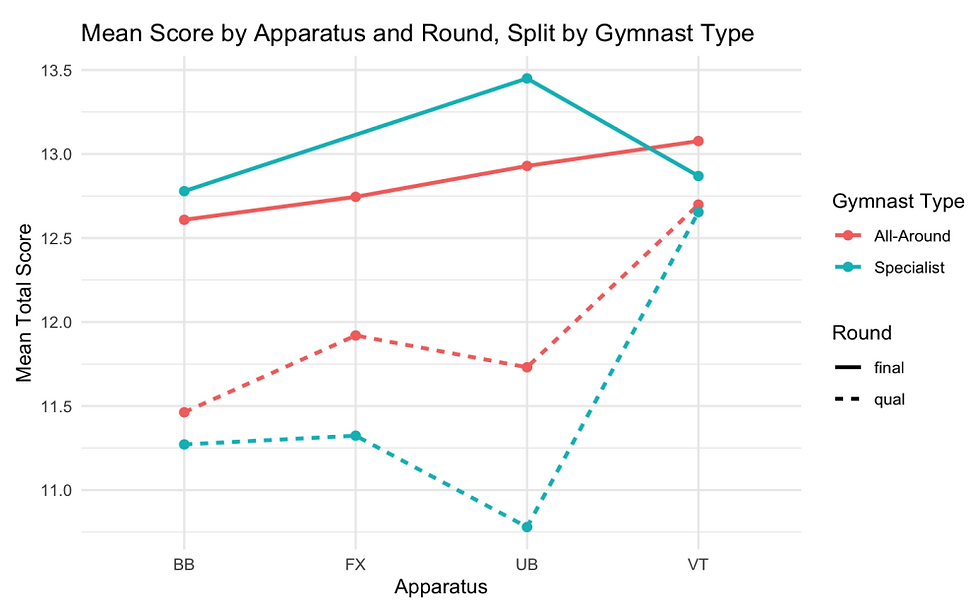

Note: There are no specialists for floor exercise (FX) in the final rounds.
Competition Round
The line graph presents a clear distinction that mean scores were higher overall in the finals than qualifiers. This is true for all apparatuses and gymnast types. The bar graph confirms this pattern as well with each bar for finals standing higher than qualifiers. Final rounds tend to possess higher stakes for gymnasts as it includes only top performers from qualifying rounds. Because final rounds include those who scored the highest, the graph verifies this trend of an increase in scores from qualifiers to finals.
All-Around vs. Specialist
Across all apparatuses, all-around gymnasts score higher in qualifying rounds. However, this trend shifts in the final rounds with specialists scoring higher in three of the four apparatuses. Typically, we expect specialists to outperform all-around gymnasts as they solely focus on one or two events. Specialists tend to show expertise in their specific apparatus, allowing them to hone their skills in fewer events. Ideally, this leads to higher performance, but this is not always the case. Interestingly, specialists only outperform all-around gymnasts in final rounds in general. This pattern suggests that all-around gymnasts may benefit in earlier rounds, but specialists are more likely to deliver successful routines in final rounds where top scores matter the most for placement.
Apparatus
In both rounds displayed by the line graph, all-around and specialist gymnasts score in similar ranges for balance beam and vault indicated by the smallest gap between the two points. Both gymnast types perform at similar levels for these events. Conversely, the uneven bar scores display the largest gap between the scores of the two gymnast types. This is followed by floor exercise, which also shows a notable difference between the scores.
Vault consistently has the highest scores due to the structure of the event. Vault allows gymnasts to perform high-difficulty routines which maximizes points. Conversely, the balance beam generally has the lowest scores as it is deemed the hardest women’s gymnastics event. The severe precision and control required to perform, leading to numerous errors and deductions. These trends are generally supported by the graphs.
Score Consistency of Specialists vs. All-Around Athletes

The first figure illustrates the variability in scores between all-around gymnasts and specialists using the standard deviations of the gymnasts’ scores. This plot captures how much each individual’s scores vary from meet to meet. In this density plot, we can see that all-around gymnasts tend to have bigger fluctuations in their scores. The average standard deviation for specialists was 0.5, while the all-rounders had an average of 0.94. The standard deviation for the specialists ranged from 0.11 to 1.30, while the all-rounders had a much wider spread, reaching up to 3.41.
The narrower distribution of the specialists suggests they perform more reliably on their given event, while all-rounders face a bigger challenge maintaining consistency across multiple events. Thus, this graph highlights the consistency advantage that comes with only having to perform in one event, compared to the higher variability that comes with competing in all four.

The second graph illustrates how specialists tend to peak higher, especially in the finals, compared to the all-rounders. All-around gymnasts have a mean score of 11.97 in the qualifier round and a mean of 12.78 in the finals. Specialists have 11.81 in the qualifiers and a mean of 12.86 in the finals.
While the score distributions are similar in the qualifiers for both types, the density in the final round nearly doubles for the specialists. This suggests that the focused training of specialists allows them to perform their best when the stakes are the highest. However, since they only have one opportunity to perform, this can also be risky, making them vulnerable to lower standings if they make any errors. Overall, these visuals show that specialists have the edge when it comes to locking in their routine during the most critical moments.
Difficulty Scoring Strategies of Specialist vs All-Around Gymnasts

As specialists focus on a single apparatus, the question arises whether they tend to attempt higher difficulty scores compared to all-around gymnasts. In our analysis, we investigated this possibility and examined how trends in difficulty scores impact gymnasts’ final scores. The scatterplot above illustrates the relationship between difficulty scores and final scores for both all-around gymnasts and specialists, with point size indicating penalties.
The graph reveals that, for both groups, higher difficulty scores are generally associated with higher final scores. All-around gymnasts dominate the data distribution, reflecting their larger sample size. Specialists, while less represented, are more concentrated around higher difficulty and final scores, potentially suggesting greater performance quality or more focused training.
However, the data does not support the assumption that specialists consistently attempt higher difficulty scores than all-around gymnasts. All-around gymnasts exhibit a broader range of difficulty scores—from near zero to over six—while specialists tend to cluster around the mid-to-high range, approaching but rarely exceeding a score of six. This contradicts the belief that specialists pursue more difficult routines, although the smaller sample size of specialists may influence this observation.
Specialists’ clustering in the mid-range of difficulty scores also leads to a narrower range of final scores, with relatively high performance likely due to their technical expertise and potentially lower penalties on their chosen apparatus. In contrast, all-around gymnasts show a wider spread of final scores at similar difficulty levels, which may reflect inconsistent proficiency across events and the impact of accumulated penalties.
Tradeoff between Execution and Difficulty Scores

As the final component of our analysis, we examined the tradeoff between difficulty and execution to determine which scoring element more strongly predicts overall performance. Our findings underscore the importance of execution in women’s gymnastics. Execution scores (E_Score) demonstrated a strong correlation of 0.75 with total scores, making them the most reliable indicator of competitive success. In contrast, difficulty scores (D_Score) showed a moderate correlation of 0.54, suggesting that while higher difficulty routines can enhance scoring potential, their impact is often mediated by execution quality and penalties.
Interestingly, we found a weak negative correlation between D_Scores and penalties (-0.26), indicating that more difficult routines do not necessarily bring greater deductions, possibly reflecting the experience level of athletes attempting complex skills or judging norms that favor higher-difficulty efforts executed cleanly.
Additionally, the distribution of E_Score revealed a bimodal shape, revealing two general performance profiles: clean routines vs. those prone to execution errors. This analysis reinforces a key takeaway from our broader study: although difficulty contributes to scoring, it is clean execution that most consistently defines competitive excellence. These insights provide a critical foundation for understanding scoring dynamics.
Our analysis of women’s gymnastics routines reveals several distinctions and insights between specialists and all-around gymnasts in scoring patterns, consistency, and strategy across all events. Specialists tend to perform better in final rounds and demonstrate higher consistency. However, they do not perform more difficult routines than all-around gymnasts. Across both groups, execution score contributes more significantly than difficulty as it correlates with higher total scores. Ultimately, our findings can aid in informing strategies and enhancing performances in women’s gymnastics.
Comments