


Predicting the 2025 NFL Draft Class
- Bruin Sports Analytics

- Dec 30, 2025
- 5 min read
By: Jared Fong and Harrison Jones
Introduction:
Predicting the success of college prospects in the NFL has been a difficult task for professional scouts and league analysts, and a perfect formula for evaluating talent has yet to be created. However, as there has become an even higher emphasis set on data analytics within the sports realm, there has been a shift in the focus of player analysis from primarily depending upon seasoned scouting veterans to analyze game film to incorporating a significant amount of statistics and advanced data into the decision making process on draft day. Still, every year, there are seemingly draft busts and steals that seem to make every model and draft analysis tool look useless. In hopes of identifying what collegiate statistic is the best indicator of professional success, we developed a model based on NFL offensive skill position players drafted in the past several years that factors in each player's college statistical performance and also their level of success in the NFL. In this article, we will use this model to predict the future success of the newest draft class of the NFL, that being the 2025 NFL draft class.
Our Draft Model:
Our model defined professional success for athletes as follows: at least one season passing for 3,750 yards (quarterbacks), rushing for 1,000 yards (running backs), or having 1,000 receiving yards (wide receivers) in the NFL. For the athletes we evaluated, we considered their height and weight, collegiate statistics from their last season starting in college, and when they were drafted. Statistics taken into account for quarterbacks were their passing yards, yards per attempt, passing touchdowns, interceptions, passer rating, rushing yards, and rushing touchdowns. For running backs, we considered their yards, yards per carry, and touchdowns. For Wide receivers, we considered their receptions, yards, yards per reception, and touchdowns. Our model then predicts whether or not a player will have a successful season (see above for our standard of “success”) based on their college production.
For quarterbacks, our model proved to be successful with decent accuracy. As of the 39 quarterbacks who were not successful, our model only predicted 4 of those quarterbacks to be successful, and our model predicted 11 quarterbacks to be successful, but in reality, 16 were. There were 11 quarterbacks who were accurately predicted to be successful, 5 who were wrongly not predicted to be successful, 4 who were wrongly predicted to be successful, and 35 who were accurately predicted not to be successful. From this data alone, it seems that our model predicts unsuccess at a high rate (35/39) = 89.7%, and success at a fair rate (11/16) = 68.75%. In total, our model was accurate for 46/55 quarterbacks for a success rate of 83.7%.
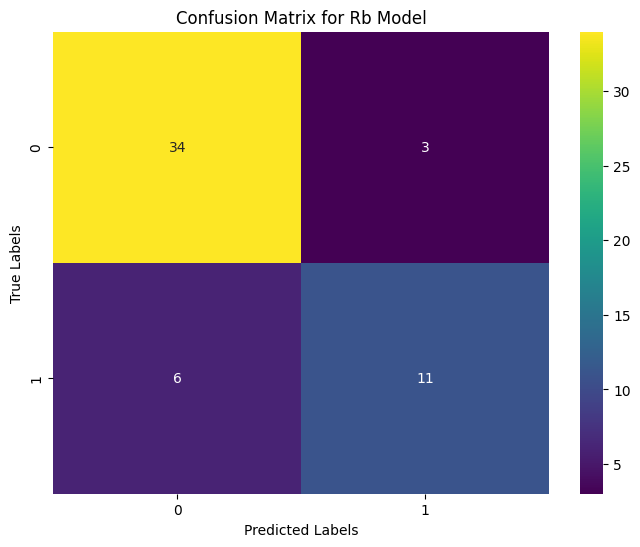
For running backs, our model also performed fairly well. Out of the 37 running backs who were unsuccessful in the NFL, our model accurately predicted 34 of them not to be successful. Out of the 17 running backs who were successful, our model predicted 11 of them to be successful. This works out for our model to have an accuracy rate of (34/37) = 0.919% when predicting a running back to be unsuccessful and an accuracy rate of (11/17) = 0.647% when predicting a running back to be successful. When comparing the accuracy rate of the model for running backs with the accuracy rate for quarterbacks, we notice that both models succeed at significantly higher rates when predicting prospects to not succeed professionally.
In total, our running back model was correct for 45/54 players (83.3%).
Our look at our model’s accuracy for wide receivers seems to further showcase this trend. Out of the 52 wide receivers who were unsuccessful in the NFL, our model accurately predicted 45 of them to be unsuccessful, and out of the 27 wide receivers who were successful, our model accurately predicted 12 of them to be. And so, when predicting unsuccessful receivers, our model had an accuracy of (45/52) = 0.865%, and when predicting successful receivers, our model had an accuracy of (15/27) = 0.556%. Once again, our model seems to be far more reliable when predicting a prospect not to be successful, but it is right over half the time in every single case. In total, our model was accurate for 60/79 receivers with an accuracy rate of 75.9%.

The 2025 NFL Draft Class
We will now use our model to predict the success of our 2025 NFL draft prospects.

Based on our model, the sole quarterback from the 2025 draft class who will have success in the NFL is Jaxson Dart, who the New York Giants selected in the back of the first round. Surprisingly, #1 overall pick Cam Ward is not predicted to succeed in the NFL, with only a predicted 29% chance of success. Leave it to the Tennessee Titans to screw up their first overall pick. Other significant names not predicted to succeed include Shedeur Sanders, Quinn Ewers, and Dillon Gabriel. These results speak to the volatility of the quarterback position and how difficult it is to evaluate year to year.

There were three wide receivers predicted to succeed in the NFL: Tetairoa McMillian (Carolina Panthers), Travis Hunter (Jacksonville Jaguars), and Matthew Golden (Green Bay Packers). Considering that these were three of the first four wide receivers off the board, these results make more sense. Wide receiver has historically been an easier position to evaluate than quarterback, so our model predicting success for some of the top prospects checks out. Notable names not predicted to succeed are Emeka Egbuka, who was picked 19th by the Buccaneers, and Jayden Higgins and Luther Burden, who were both picked at the top of the second round.

For our running backs, TreVeyon Henderson, Omarion Hampton, and Quinshon Judkins are predicted to succeed, with the biggest shock being Ashton Jeanty, the 6th overall pick in the draft, not being predicted to succeed. Jeanty led the NCAAF with 2,601 rushing yards, so our model not liking him is surprising to say the least. This speaks to the nature of the running back position - the more wear and tear on a running back, the harder it is to see their long-term success in the NFL. Jeanty had at least 90 more carries than any other back in this draft class, which could contribute to our model not being confident in his future. Meanwhile, Treybon Henderson, who our model predicts to have the highest chance at success, had only 144 carries, an entire 230 less than Jeanty. Considering our model has a 91.9% success rate when predicting running backs to be unsuccessful, it is surprising to see Jeanty fall short.
Our model seems to be fairly conservative - only 7 offensive skill players are predicted to have at least one successful NFL season. The results of our model seem to accurately reflect the difficulties modern scouts have in scouting across different positions, with only one quarterback projected to succeed despite five being taken in the first three rounds. It is important to note the limitations of our model, considering it only considers data since 2018, and only considers the statistical performance of the player’s last season in college. Still, our model predicted success with a success rate of higher than 50% in all categories across quarterbacks, receivers, and running backs, and could be used as a useful tool when predicting success for the 2025 draft class. Keep your eye out for Jaxon Dart, Treyvon Henderson, and Tetoria McMillan in our dynasty draft this summer.

Comments